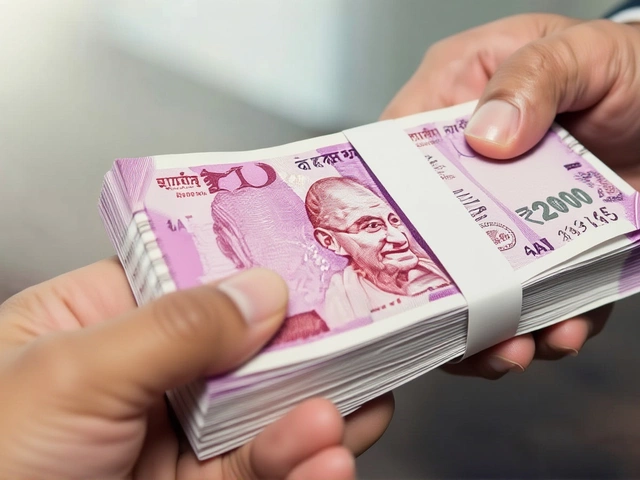
Indian Rupee Hits 2025 Low Against US Dollar as Rate Slips to 89.92 INR per USD

By the end of 2025, the Indian Rupee had sunk to its weakest level against the US Dollar in over a decade, with the exchange rate hitting 89.92 INR per USD on December 2 — a far cry from the 85.35 INR/USD seen just months earlier. The Reserve Bank of India watched helplessly as capital outflows, rising U.S. interest rates, and global risk aversion hammered the rupee. The year ended with the currency down 5.09% against the dollar, and the average rate for 2025 stood at precisely 1 INR = 0.01151 USD — or 100 INR = 1.151 USD. Claims circulating online that 100 INR equaled 1.29 USD? Those are flat-out wrong, and dangerously misleading for travelers and businesses alike.
Why the Rupee Kept Falling
The depreciation wasn’t sudden. It was a slow bleed, punctuated by sharp drops. In January, the rupee hovered around 85.40 INR per USD. By May, it had slipped to an average of 85.20 — already a 2.5% decline from the start of the year. But the real plunge came in the final quarter. December 2025 saw the USD/INR pair climb from 87.6 to nearly 90.3. On December 3, the rate spiked to 90.295 INR per USD — the highest in recorded history for the year. That single day’s move of over 1.2% was the largest one-day swing since March.What caused it? Three things: First, the U.S. Federal Reserve held rates at 5.25%-5.50%, making dollar-denominated assets far more attractive. Second, global investors pulled money out of emerging markets, including India, as fears of a U.S. recession faded. Third, India’s current account deficit widened slightly to 2.1% of GDP, putting more pressure on foreign exchange reserves.
Monthly Volatility: A Rollercoaster Year
The data tells a clear story. X-Rates.com recorded monthly averages that show the rupee steadily weakening:- January 2025: 86.23 INR/USD
- February 2025: 86.96 INR/USD
- March 2025: 86.62 INR/USD
- April 2025: 85.60 INR/USD
- May 2025: 85.20 INR/USD
- June 2025: 85.93 INR/USD
- November 2025: 88.45 INR/USD
- December 2025: 89.15 INR/USD (average)
That’s not a trend — it’s a collapse. The most volatile week? Late November to early December. On November 26, the rupee hit a monthly high of 89.1605 INR/USD. Just a week later, on December 3, it plunged to 90.295. That’s a 1.27% swing in seven days — a massive move in currency markets.
Who’s Feeling the Pain?
It’s not just economists who are watching. Indian importers are paying more for oil, electronics, and machinery. A company importing $1 million worth of semiconductors in January paid ₹85.4 million. By December, that same import cost ₹90.3 million — an extra ₹4.9 million, or nearly ₹50 lakhs, in just 11 months. Small businesses that rely on imported raw materials are cutting back. Exporters, meanwhile, are celebrating — their goods suddenly look cheaper abroad. But that’s a double-edged sword: if the rupee falls too fast, it can spark inflation and force the Reserve Bank of India to intervene with foreign reserves.Travelers are also feeling it. A family planning a $5,000 trip to the U.S. in January needed ₹4.27 million. By December, they needed ₹4.52 million. That’s a 5.8% increase in travel costs — enough to cancel a vacation or skip a hotel upgrade.
What’s Next? The Fed, Oil, and the RBI’s Dilemma
The path forward hinges on three things. First, the U.S. Federal Reserve’s next move. If it cuts rates in mid-2026, the dollar could weaken — and the rupee might rebound. Second, oil prices. India imports over 85% of its crude. A spike in Brent crude above $85/barrel would crush the rupee again. Third, the Reserve Bank of India’s willingness to sell dollars from its reserves. It did so in August and October, but reserves are now down to $585 billion — the lowest since early 2023. If the rupee slips below 91, intervention may become unavoidable.There’s a quiet worry among analysts: Is this just a cyclical dip — or the start of a structural shift? The rupee has lost 25% of its value against the dollar since 2020. That’s not just inflation. It’s a loss of confidence. And confidence, once broken, is hard to rebuild.
What the Numbers Don’t Show
Behind the charts are real lives. A vendor in Mumbai who buys Chinese phone parts sees his margins vanish. A student in Bengaluru who dreamed of studying in the U.S. now needs to apply for twice as many scholarships. A farmer in Punjab who buys imported fertilizer pays 12% more than last year. These aren’t abstract economic indicators. They’re daily burdens.Frequently Asked Questions
Why did the Indian Rupee weaken so sharply in late 2025?
The rupee’s sharp drop in late 2025 was driven by the U.S. Federal Reserve holding interest rates high, making the dollar more attractive to global investors. Simultaneously, India’s current account deficit widened, and foreign portfolio investors pulled capital out of Indian markets. The combination of strong dollar demand and reduced rupee demand pushed the exchange rate from 87.6 to nearly 90.3 INR per USD in just two months.
Is the 1.29 USD per 100 INR claim accurate?
No, that claim is false. The highest rate in 2025 was 89.917 INR per USD on December 2 — meaning 100 INR was worth only $1.112. Even at its peak, 100 INR never reached $1.29. That figure likely confuses outdated data or misrepresents a different currency pair. Reliable sources like X-Rates.com and Exchange-Rates.org confirm the correct rates.
How did the Reserve Bank of India respond to the depreciation?
The Reserve Bank of India intervened in August and October 2025 by selling dollars from its foreign reserves to stabilize the rupee, but avoided large-scale action in December to preserve reserves. It also raised short-term borrowing costs for banks and encouraged non-resident deposits in rupees. Still, with reserves at $585 billion, options are limited if the rupee slips below 91 INR per USD.
What does this mean for Indian exporters?
Indian exporters benefited significantly, as their goods became cheaper overseas. Textile, pharmaceutical, and IT service exports saw a 7-12% boost in demand from the U.S. and Europe. However, many exporters locked in forward contracts at lower rates earlier in the year, so the full benefit wasn’t realized. Those who waited for the depreciation saw higher margins, but also faced increased competition.
Could the rupee recover in 2026?
A recovery is possible — but not guaranteed. If the U.S. Federal Reserve cuts rates in Q2 2026, the dollar could weaken, giving the rupee breathing room. Stronger export growth, lower oil prices, or a surge in foreign direct investment could also help. But if inflation stays above 5% and fiscal deficits widen, the rupee may stay under pressure. Most analysts expect a range of 87–90 INR/USD in early 2026.
How does this compare to historical rupee depreciation?
The 2025 depreciation was the most severe since 2013, when the rupee fell to 68.85 INR/USD amid the ‘taper tantrum.’ Since then, the rupee has lost nearly 30% of its value against the dollar. In 2025, it fell faster than in 2018 or 2022, despite India’s stronger macroeconomic fundamentals. The speed of the drop suggests deeper investor concerns about global risk appetite, not just domestic issues.